I make my living building websites, and I am writing an article about when you should not hire me to build one. The reason is simple: someone I honestly tell “you can handle this yourself” comes back two years later with a job an AI cannot cover. Someone I sell more than they need never comes back at all.
Where AI genuinely closes the job
Not “nearly closes”. Not “closes with caveats”. Closes.
A brochure site. Name, what you do, phone, address, contact form. Current tools assemble that page in an evening, and the result will be tidier than half the sites people paid for in 2019.
A one-pager for a specific offer. An event, a course, a single product, a waiting list. Narrow job, short life, and paying an agency for it is waste.
Draft copy. Page structure, headline options, a first pass at service descriptions. You edit it into your own voice afterwards — but AI clears the blank page well.
Images and illustrations. For the blog, for social, for page decoration.
Making sense of someone else’s code. When you need to know what that script the previous contractor installed actually does.
If your job is on that list, do it yourself. The tools are available, the barrier is low, and you will save money better spent on advertising.
There is nothing wrong with someone building a site themselves. What is wrong is paying for something they could have done in an evening.
What does not transfer to a tool
Now the other half — and it is not about quality. It is about what a tool does not have by definition.
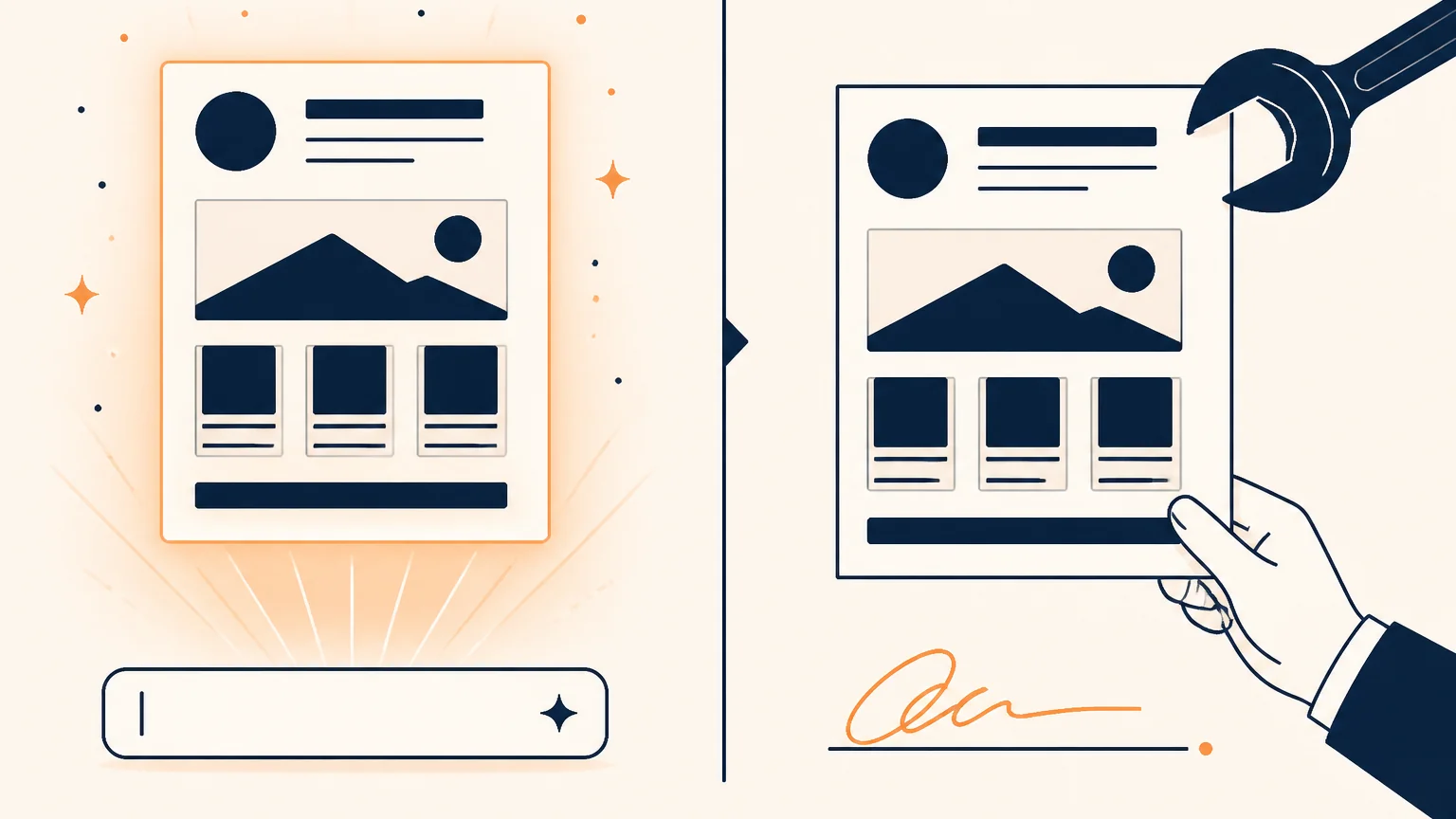
Accountability. An AI does not sign a contract. If the site goes down during an ad campaign, there is nobody to ask. If customer data leaks through a badly configured form, likewise. Accountability is not a property of code; it is a property of the person who signed.
Talking to other people’s systems. CRM, payment provider, warehouse, accounting, booking calendar. Each with its own documentation, keys, limits and surprises. AI will write the code to call any of them. But when the provider changes its response format and payments stop going through on a Friday evening, a human has to work it out.
Compliance with local law. The model knows perfectly well what the GDPR is. It does not know that in your case form submissions go to a mailbox in a country whose processing terms you never checked. And it does not know your cookie banner is configured so the analytics tag fires before consent. That is not a knowledge problem — it is a question of who walked through the actual site and looked.
Support a year from now. A website is not a finished object, it is a process. Platform updates break compatibility, plugins stop being maintained, hosts change the language version. In a year someone has to fix that.
Choosing what not to build. The most underrated part of the work. Half the value of hiring someone is being talked out of ideas that sound good and do not work.
What this looks like in practice
People come to me with sites assembled in an evening with AI. Quite often they are fine: the page works, the form sends, the owner is happy. The job in those cases is not “rebuild everything” but to finish what is missing: connect the form to a CRM, remove external fonts, sort out the privacy policy.
The opposite also happens: the site looks respectable, and underneath sit three payment integrations built from prompts, with nobody remembering where the keys are stored. That is also a normal situation — it just takes longer to fix than to build.
The line is not drawn by what the site was made with. It is drawn by how much accountability it carries.
Check yourself in a minute
Answer four questions.
- If the site stops working on a Monday morning, who notices and who fixes it?
- How many other systems need to exchange data with it?
- Who is answerable if visitors’ data goes somewhere it should not?
- Who will update it a year from now?
If the answer to all four is “me, and I’m fine with that”, you genuinely do not need a contractor. That is not sarcasm: plenty of businesses run perfectly well on a site the owner maintains.
If two of those questions gave you pause, the question is not whether to build it yourself. The question is who is accountable.
What to check on a site built with AI
If the site already exists and works, it is worth running through a short list. These are the places where tools most often leave loose ends.
- External assets. Fonts and libraries loaded from someone else’s server. In Europe this is the most common trigger for complaints.
- The form. Where the enquiry goes and whether it arrives at all. Send yourself a test and check it did not land in spam.
- Mandatory pages. Provider details and a privacy policy matching what actually happens on the site.
- Speed. Generated code can be bloated: a hundred-kilobyte page turns into several megabytes.
- Mobile screens. Test on a phone, not in a narrowed browser window. They are different things.
- Credentials. Where the hosting and admin passwords live, and whether you have them rather than just a chat history.
Half the list can be closed in an evening. That is cheaper than rebuilding.
What I think about all this
I use AI in my work every day. I have twenty-three AI agents in my stack; they write code, work through documentation, prepare drafts. The tools have improved to the point that part of my former job is no longer needed by anyone — and that is right.
What changed is something else. Clients used to pay for someone who knew how to build it. Now they pay for someone who is accountable for the outcome and reachable when it breaks. AI took the first. It will not take the second until it learns to sign contracts.
If you need the first, do it yourself — I mean that. If you need the second, see how I work and start with a free conversation: if the job can be solved without me, I will say so.
And on where a website builder is the right stop and where it hits the ceiling, see “I built the site on a website builder. Three years later it was too late to move”.
Checked on 26 July 2026.